
The Way of St. James through the Rioja Alavesa (Codex Calixtinus)


We continue with our special collaborations. This time, vueltaabierta.com presents one of the curiosities of the Camino; we hope you enjoy it.
The Camino de Santiago through Rioja Alavesa
The most well-known and frequently traveled route of the Camino de Santiago is the one that crosses the Pyrenees from France, reaches Roncesvalles, passes through Logroño, Burgos, León, Astorga, Sarria, and Arzúa, and ends in Santiago. But it is not the only one. It is said that as early as the 14th century, nobles chose alternative routes to avoid the crowds of pilgrims from lower classes. One of these alternative routes passes through what is now the Rioja Alavesa region. At the end of the 14th century, Charles of Navarre (Charles III the Noble) embarked on this adventure on horseback. Everything seems to indicate that this twenty-something prince was not the first to choose this route, and that if he did, it was because he was certain that sufficient infrastructure already existed in the towns where he stopped for his retinue of nearly one hundred people.
As the historian Salvador Velilla Córdoba explains in “To Santiago de Compostela through Rioja Alavesa” (http://www.
In Samaniego, a 17th-century palace still stands, now a charming and wonderful hotel that once served as lodging for pilgrims on the Camino de Santiago. Its walls still display several symbols associated with the Camino, such as the scallop shell above the entrance. Jon Ugalde, the excellent chef from San Sebastián who runs the hotel and its exquisite cuisine, will explain in great detail the building's original layout and its Compostela symbols. If you'd like to learn more about this palace, I invite you to visit www.vueltaabierta.com
Are you interested in the Codex Calixtinus? See the facsimile edition of the Iacobus Codex Calixtinus and the Spanish translation of Book V in the Club store.

About author

Related posts
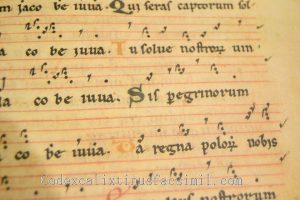
POLYPHONY IN THE CALIXTINO CODEX EVA ESTEVE ROLDÁN Higher Conservatory of Music of Zaragoza INTRODUCTION We will try to delve into the Middle Ages and during a... Continue reading
Add comment
You must be logged in to post a comment.