
The Codex Calixtinus and the history of music
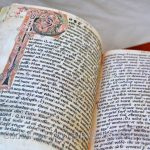
The Codex Calixtinus contains 22 polyphonic compositions. These pieces belong to the first period of European polyphony, called Ars antiqua or Ars veterum, which refers to the music made in Europe between 1170 and 1310. This musical school has as its central axis what would eventually become the Notre Dame school.
The creations are more elaborate than those made by the school of Saint Martial of Limoges, so although at first they were linked to this school they were eventually considered closer to what would eventually become the school of Notre Dame.
The main characteristics of Ars Antiqua are the conductus and the organum. In it conductus the lead voice is the trope of the polyphonic piece, while the organ voice It is a more or less embellished melody in the high register. These polyphonic tropes sometimes have a responsorial form, including a short refrain after each verse, as occurs with the Congaudeant catholici.
While the organum It consists of a monophonic Gregorian melody (lead voice), to which, at a certain point, a second voice is added (organ voice) which develops a long and ornate melody. This second voice can be at the beginning, in the middle or towards the end of the composition, but it generally ends with the monophonic melody.
The manuscript preserved, until its unfortunate theft, in the Cathedral of Santiago is the first codex in which the term conductus is used and apart from some compositions from abbeys in Catalonia, they are the oldest musical compositions of the Iberian Peninsula.
The authorship of these works is debated among researchers, although most believe that 16 authors participated in the creation of the different compositions that appear in the manuscript, including French bishops and musical masters. Aymeric Picaud, a priest from Parthenay, is one of them, and he is credited with the authorship of the Codex and also a work in the polyphonic appendix.
(Benedicamus Domino, Thank you) (Graduale)All the musical compositions in the Codex Calixtinus are two-voice polyphonies, except for the one shown below. It is believed that at the time of its creation, it was a piece conceived for two voices, and that a third voice was later added, making this composition one of the most original in the manuscript. Studies indicate that the voice added later was written in red ink, not black like the originals.
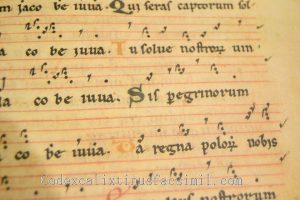
(Congaudeant catholici)He «Dum pater familias» It is the only composition in the codex in Aquitanian dot notation «in campo aperto», which is the notation that was primarily used in Spain after the suppression of Hispanic chant. The rest of the works are in Lorraine notation, which bears a strong resemblance to the notation of manuscripts from the Nevers region of Burgundy. For this reason, some specialists maintain that the musical portion of the codex is the work of the Benedictine monks of Vézelay, which was one of the starting points of the Camino de Santiago (Way of St. James). The hymn «Dum pater familias», The text, added at the end of the codex, would therefore be the only composition that could have been copied in the vicinity of Santiago. Furthermore, it is the last of the Benedicamus in the Gregorian supplement to Book I., «Regi perennis glorie», It is attributed to a certain doctor from Galicia (Quodam Doctore Galleciano) unidentified.
(Dum Pater Familias)Today, numerous transcriptions and modern recordings make these wonderful compositions accessible to us. In fact, these pieces, considered among the most important for Gregorian chant performers, are still performed in many monasteries. For example, our friends at the Monastery of Santa Brígida in the Canary Islands: http://www.monasteriodelasantisimatrinidad.es/home.html
Sources: Wikipedia.
YouTube.
http://ec.aciprensa.com
Are you interested in the Codex Calixtinus? See the facsimile edition of the Iacobus Codex Calixtinus and the Spanish translation of Book V in the Club store.

About author

Related posts
POLYPHONY IN THE CALIXTINO CODEX EVA ESTEVE ROLDÁN Higher Conservatory of Music of Zaragoza INTRODUCTION We will try to delve into the Middle Ages and during a... Continue reading
One comment
Pingback:
Codex Calixtinus | Cloud Travelers 2.0